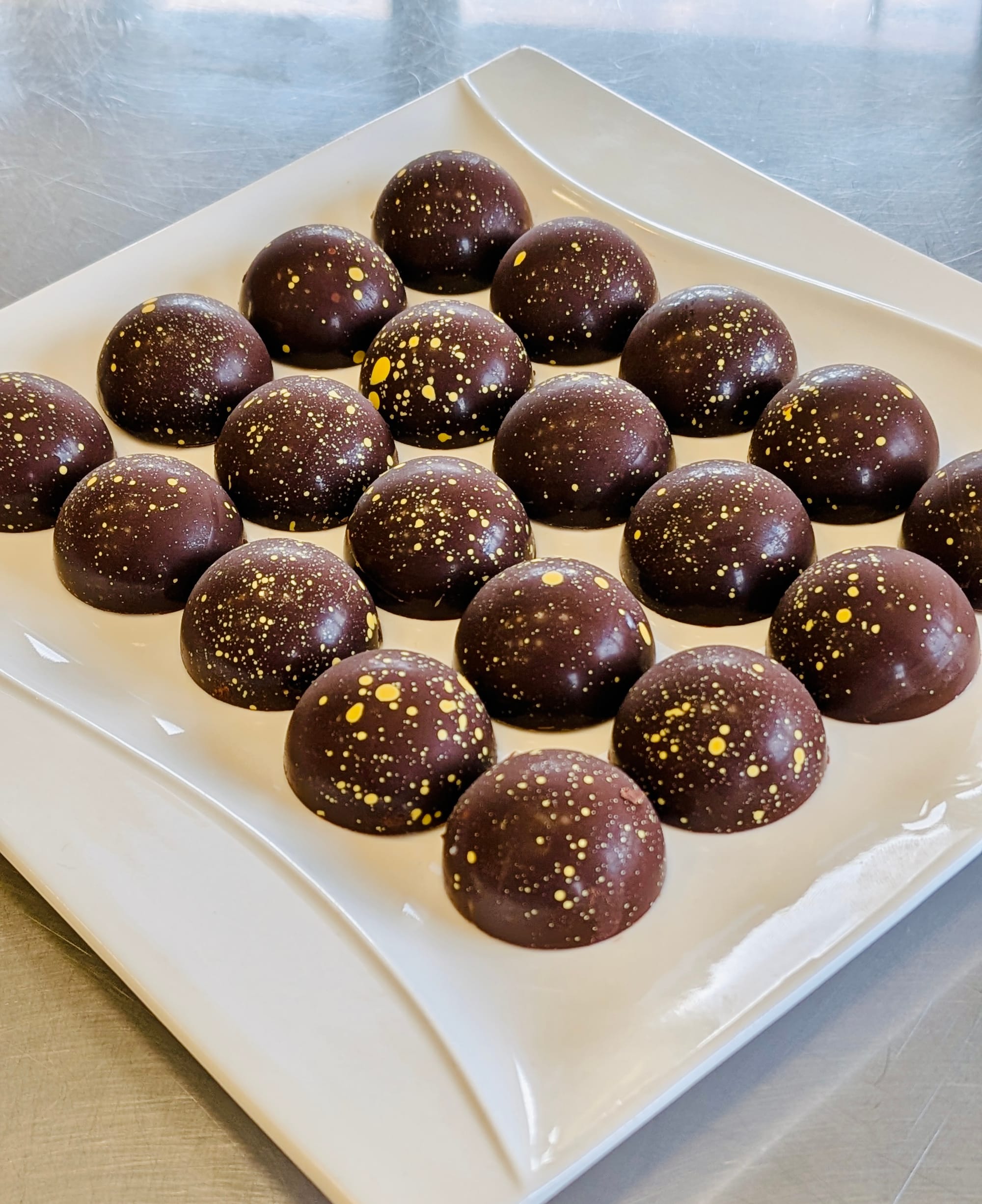
Coconut and Pandan Bonbons with Cardamom
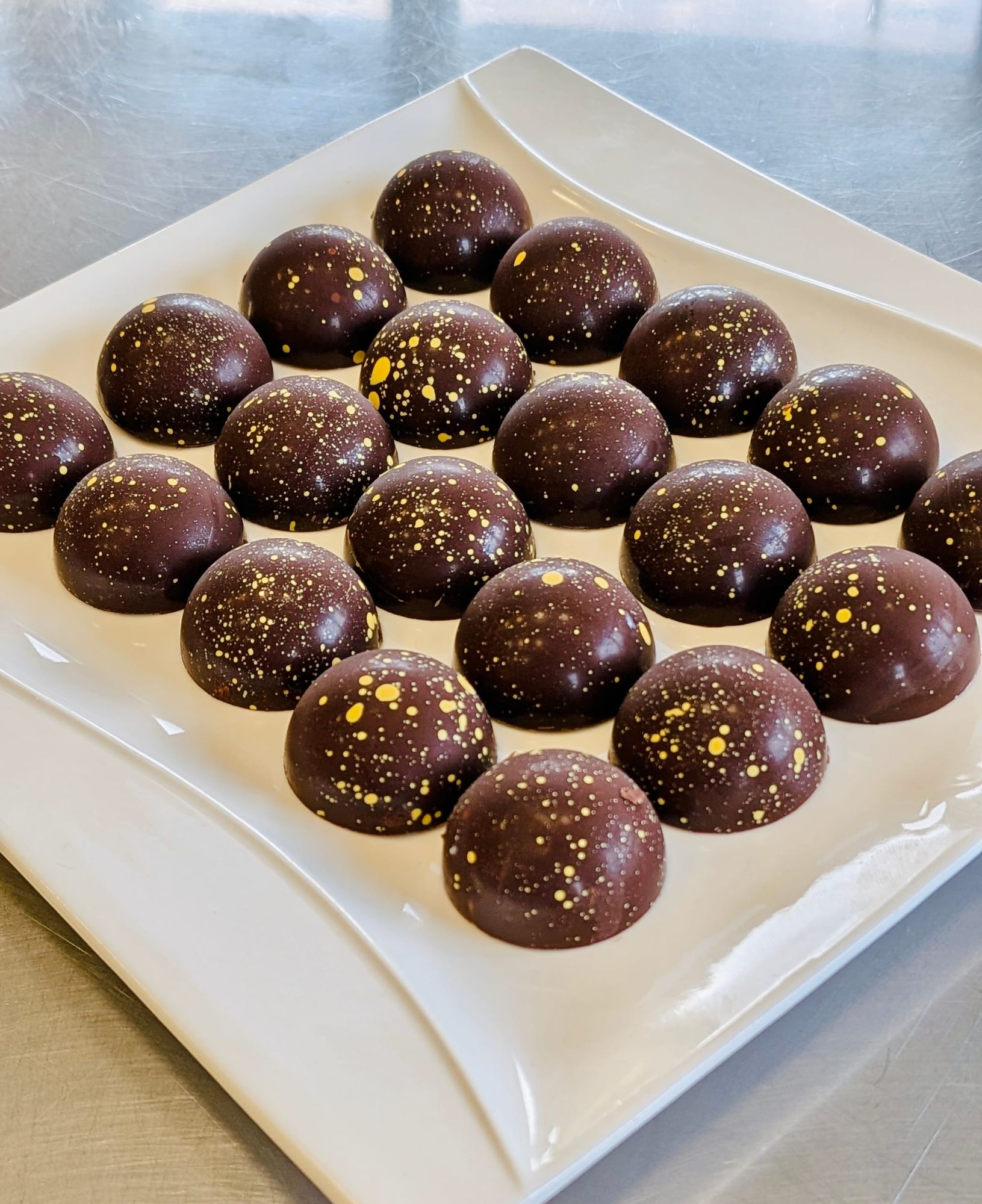
Yield: 28 units
Allergens: Dairy
About the Dish
When you think of countries associated with chocolate, Sri Lanka does not automatically spring to mind. However, the country has been growing cocoa since the plant was introduced during the British colonial occupation in the early 1800s. When it first arrived on the island, cocoa was often planted as under-growing crops for coconut and rubber plantations. Today, cocoa is being produced in Sri Lanka on a wider scale as demand for the product increases, although it is still small compared to other agricultural sectors in the country.
Even though it may not yet be in the mainstream, Sri Lankan cocoa is growing in popularity as a high-quality option with fruity and floral undertones.
I grew up eating Sri Lankan chocolate, so today I thought I would make a bonbon designed to represent some of my favorite flavours from the island. Most savoury recipes in Sri Lanka include some use of coconut, pandan, and cardamom—flavours that also work well with sweet dishes, and especially with chocolate!
Ingredient Guidance
- Cardamom: Use green cardamom, not black. Green cardamom has a sweet and floral flavour profile that works with desserts. Green cardamom is also native to Sri Lanka and the South Asian region, whilst black cardamom is not.
- Chocolate: Use medium-fluidity chocolate for both the dark and white chocolate (3/5).
Equipment
- Polycarbonate mould
- Rubber spatula
- Thermometer
- Metal bench scraper
- Paintbrush
- Large offset spatula
- Cotton balls
- Microplane
Ingredients
The Chocolate & Cocoa
- 300g + 200g dark chocolate (separated)
- 100g white chocolate
- 10g cocoa butter
- 2–3 drops cocoa colouring (optional)
The Filling & Flavourings
- 50ml cream
- 45g coconut puree
- 3 cardamom pods
- 2 pieces of pandan leaf (approx. 15cm each)
- Zest of ½ a lime
Mise en Place
- Zest the lime with a microplane.
- Crush the cardamom pods.
- Cut 2 pieces of pandan, roughly 15cm long.
- Add 2–3 drops of cocoa colouring to the cocoa butter and melt them together until combined.
- Make sure to polish the polycarbonate bonbon moulds thoroughly with the cotton balls.
Methods & Procedures
For the Cocoa Colour
- Start by tempering the cocoa butter. Place a small pot on a very low heat and place about a centimetre of water in the pot.
- Place the cocoa colour in a small bowl or jar and place it into the simmering water to melt. Let it melt about 80% and then let the residual heat melt the rest.
- Stir the cocoa with a paintbrush. Once completely melted, take the temperature.
- Use a cold-water/ice bath to cool down the cocoa colour to 32 degrees Celsius before using.
- Use the paintbrush to pick up some of the colour and flick/spray it into the moulds.
- Let the cocoa colour set for about 10 minutes before applying the tempered dark chocolate to the polycarbonate mould.
For the Bonbon Shell
- Start by tempering the larger amount (300g) of dark chocolate.
- Place the chocolate in a bowl and place it over a bain-marie to melt.
- Once melted by 80%, take it off the heat and keep stirring until completely melted. Make sure the chocolate has surpassed 45 degrees Celsius.
- Use an ice or cold-water bath to bring down the temperature of the dark chocolate to between 29–30 degrees Celsius, whilst stirring continuously with a rubber spatula. Make sure to test the temperature from time to time as you are stirring.
- Once it has reached the desired temperature, place it back on the bain-marie for 5 seconds to increase the heat by just 1 degree to between 31–32 degrees; this helps to bring the shine back to the chocolate. The chocolate is now tempered and ready to use.
- Pour the chocolate into the polycarbonate mould lined with the cocoa colour and use a bench scraper to spread the chocolate to fill all the holes.
- Working quickly, turn the moulds around and tap the sides with the spatula to empty the mould of the excess chocolate, until only a thin layer of chocolate is left lining the polycarbonate. (It is recommended to tap the chocolate out over a tray lined with parchment paper so that you can collect and reuse the chocolate.)
- Let the chocolate in the polycarbonate mould set upside down on the edge of the tray until the chocolate starts to turn matte in colour. Then, use a metal bench scraper to gently remove the excess chocolate lining the edges around the spherical holes.
- Let the chocolate set. You can also put it in the freezer to quicken the process, but it will happen at room temperature as long as it is tempered properly, and your room temperature isn’t above 29 degrees.
For the Filling
- Start by combining the cream, crushed cardamom, lime zest, and pandan in a small pot and bring to the scalding point of the cream, around 70 degrees Celsius.
- Mix the white chocolate into the cream once it has dropped below 60 degrees (above that temperature, chocolate can burn).
- Then, mix in the coconut puree.
- Let the flavours infuse, then strain out the pandan, cardamom, and zest.
- Check the temperature of the filling, making sure it is below 32 degrees, before you transfer the ganache to a piping bag.
- Cut a small hole in the piping bag, roughly 1cm in diameter, and fill the chocolate-lined polycarbonate mould 90% of the way, leaving some space to be able to close the bonbons with more tempered dark chocolate.
- Place the filled bonbons into the freezer for 30 minutes before closing.
For the Closing
- Temper the remaining dark chocolate (200g) the same way as before.
- Pour the tempered chocolate over the chilled, filled bonbons and use a large offset spatula to scrape the chocolate off from the top end of the mould to the base.
- Let the chocolate turn matte again before using the metal bench scraper to gently remove the excess chocolate.
- Place in a freezer for 10 minutes before demoulding the bonbons. This is done by turning the mould over and giving it a gentle tap so they fall out.
Storage
Can be stored in the freezer for up to 3 months, or in the fridge for 5 days.
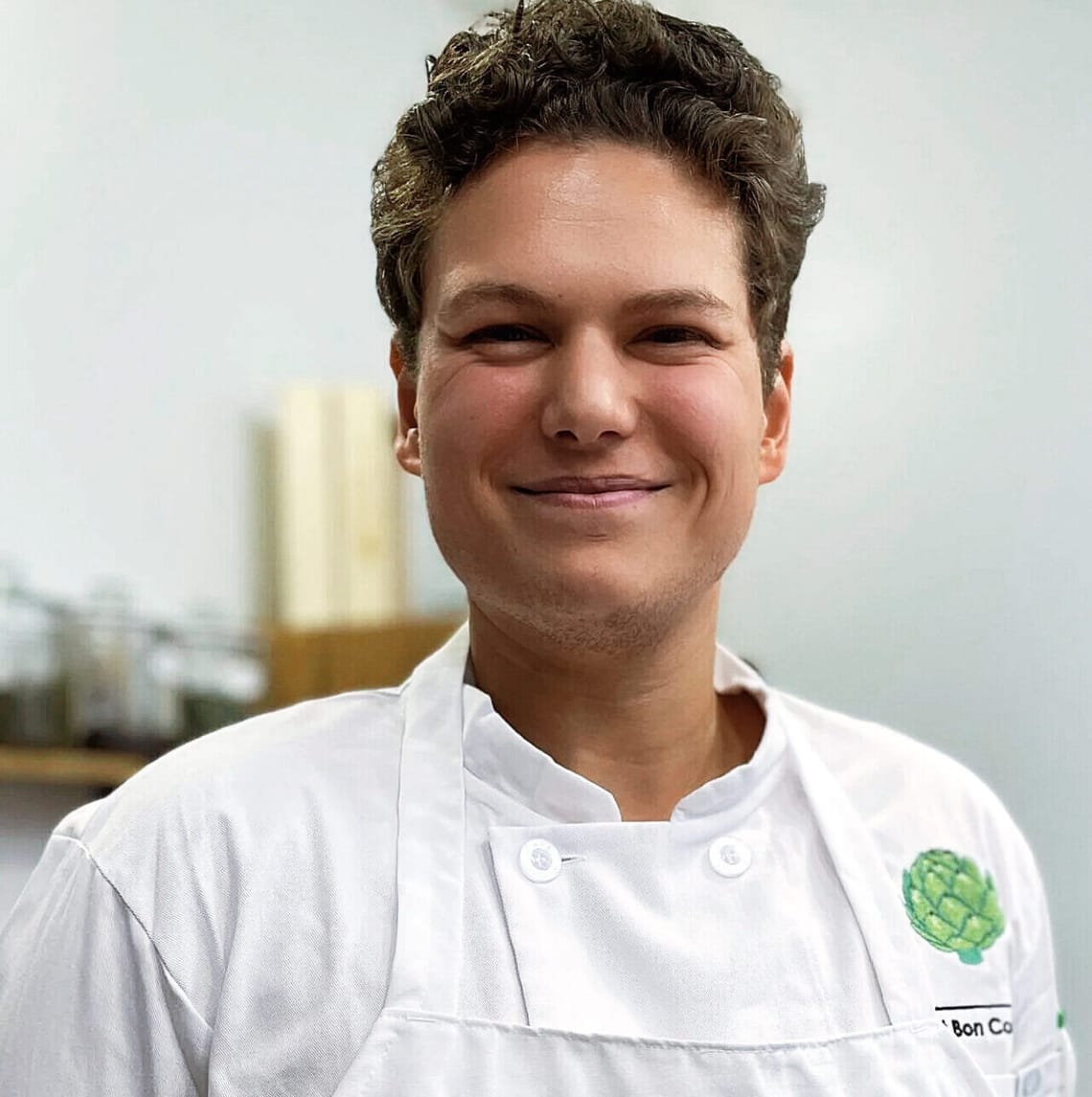
Co-founder of Snout & Seek. Born and raised in Sri Lanka, Arnold's passion for food stems from both his Dutch and Sri Lankan roots. A graduate of Le Cordon Bleu Ottawa, Arnold's career in the culinary industry has brought him from the Netherlands to Canada, where he now teaches at a cooking school.
No spam, no sharing to third party. Only you and me.
Member discussion